Jev Isn't an LLM, and That's the Point
I tested TypeSafe's new Jev model against two years of my own journal entries, and the whole thing cost three cents. Here's what it got right, what it missed, and why it's 26x to 131x cheaper than reaching for an LLM.
The current hotness is Jev. People have been singing its praises everywhere, with most claiming it is the next big thing. Is it worth the hype? That is the question I aim to find out for myself. I got access to Jev by applying to TypeSafe's invite program.
Jev is TypeSafe AI's first "System One" model, launched in 2026. Unlike a generative LLM, it doesn't produce text, it returns a typed, calibrated decision (a probability, a pick from your choices, or a score) for whatever question you ask it.
What is Jev, actually?
At the core it is a classifier. It is not a generative LLM. It doesn't generate text. But you ask a question, and it gives a structured answer. There are three types of answer it can give. But at the heart of the system, you ask, it answers.
It can give you a Noul, a probability answer to a yes or no question, not a flat boolean. Or it can pick from a multiple choice you provide. This is classification. Or it can score across multiple criteria. Think of confidence scores.
To further simplify, you ask a question, give the choices, and Jev replies with a score and another stat on how confident it is about the score. That's all Jev does.
Models like Fable and Astra are capable of doing this. But the question here is the cost. Jev does what these models do but at a fraction of the cost. That is the advantage of a model being narrow in its function. And Jev is also blazingly fast. You can ask multiple questions in one call and it will process them in parallel.
The idea that didn't work
Ideally, I want to see for myself what Jev is capable of. My initial idea was to build a movie recommendation engine based on my tastes. I have a good enough dataset of 1000+ movies I have logged in my Letterboxd account.
And that was my first hurdle. Jev can't make tool calls, and it can't gather context on its own. I have to provide context in my API call. How would I package my data? I can't feed it 1000+ personal notes every time I ask it if a movie is a good fit for me. Plus, I wasn't sure if Jev had real world data in it. So Jev would have to rely on TMDB's metadata.
Then I shifted my thinking. I needed a dataset that didn't rely on outside knowledge, something purely semantic. That's when I thought about my personal daily notes I have in Obsidian, and thought I could do mood analysis on them.
The actual build
I had around 500+ daily notes of free prose. These weren't structured. It was just me rambling about my day. And it wasn't even a lot, median sits around 97 words. From Nov 2024 to Sep 2026, around 80% of the days had a note.
One issue I had is, I already tagged these notes based on my mood. That was a blessing too, I had a source of truth.
So I set up a pipeline, parse the data, clean it and send it to Jev with a set of questions.
class DayReading(BaseModel):
    emotion: Emotion            # happy sad anger fear surprise disgust neutral
    state: State                # restless depleted content uneasy accomplished none
    centre_of_gravity: Centre   # building consuming paid_work people errands rest out none
    productive: float           # 0 to 1
    finished_something: float
    went_as_intended: float
    human_contact: float
Python Block
- emotion — a Choice question across seven options: happy, sad, anger, fear, surprise, disgust, neutral. Jev picks the one with the highest probability out of a distribution that has to sum to 1.
- state — another Choice question, six options this time: restless, depleted, content, uneasy, accomplished, or none of these. Same mechanism, different set of options.
- centre_of_gravity — a Choice question for what the day was mostly about: building something, consuming media, paid work, people, errands, rest, out, or none.
- productive — a Noul. A probability from 0 to 1 that the day was productive, not a flat yes or no.
- finished_something — a Noul. The probability I actually finished something that day.
- went_as_intended — a Noul. The probability the day went the way I expected it to.
- human_contact — a Noul. The probability the day involved real contact with another person.
The first three compete against each other inside their own question, since Choice hands you one distribution and the options split that probability mass. The last four don't compete with anything, each one is its own independent question, so a day can score high on more than one of them at once.
What came back
393 days scored, 2,751 individual judgments, one request per day. Wall clock was about 4 minutes running 8 requests at a time.
Half the days, 50%, had media, watching or playing something, as their centre of gravity. A distant second was making something, at 17%, then time with people at 10%.

Emotionally, most days read as unremarkable. 71% came back neutral or happy. The most common state wasn't calm or accomplished, it was something unresolved, 31% of days landed there.

On the four independent questions: productive came back 44%, went as intended 42%, finished something 40%, and real human contact, only 26%. That last one is the one that stuck with me the most.
Zoom out to months and the productive number swings hard, from 8% in one month to 82% in another. And two of the seven emotion options barely showed up at all across 393 days. Surprise was the top pick twice. Disgust, five times. Turns out an ordinary life doesn't generate a lot of surprise or disgust, at least not the kind you'd write down.

Three cents
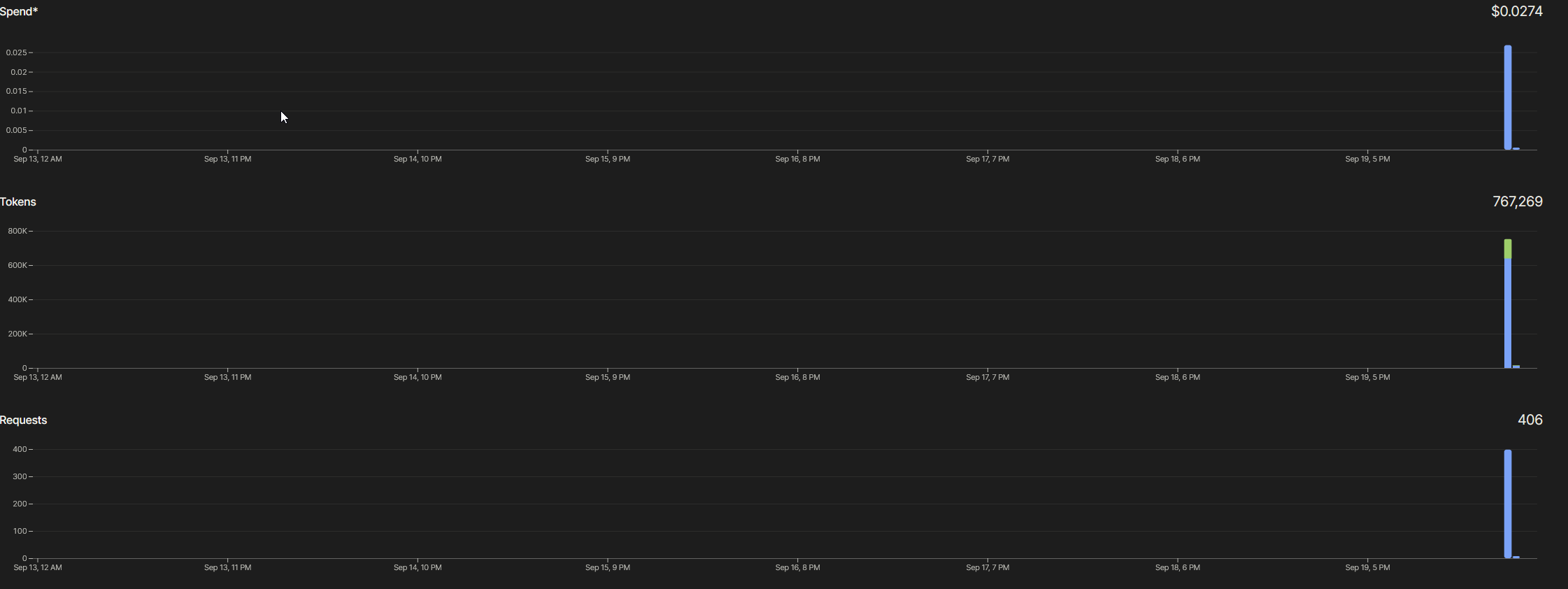
Now the number that actually matters for this post. All of that, 406 requests, 767,269 tokens total, cost me $0.0274. Under three cents.
Run the same workload through a generative model instead, and even with prompt caching turned on, you're looking at roughly $0.72 on Haiku, $1.44 on Sonnet, or $3.60 on Opus. That's still 26x to 131x more expensive than Jev, for the exact same task.
Where I'm being generous to the other side
Before I get too pleased with myself, worth naming what this comparison leaves out. I didn't count thinking tokens, retries on malformed output, or the extra prompt a generative model would need just to describe the schema, all of which would only make the LLM side more expensive, not less. There's a deeper difference too. When an LLM gives you a 0.7, that's a sampled token, not a real probability. Jev's 0.7 actually is one, and if you plan to threshold or regress on that number later, that's not a small difference.
So the honest claim isn't "Jev is cheaper." It's that for structured judgment like this, it's 26x to 131x cheaper depending on the model, and every assumption I made favored the other side.
Where else this fits
In the real world, there are a lot of use cases where Jev is a perfect fit. Any closed environment where a decision has to be made, Jev is a good fit for it. I can see Jev being used in world simulations. There are already early examples of Jev playing games, chess benchmarks and NPC decision-making among them.
On the agent side, Jev can be used as a router to pick the right model for a task. I can also see it working as middleware, matching the right tool to a call, picking from a bounded set of tools the same way it picks from a bounded set of moves in a game.
Other obvious picks are text classification, sorting support tickets, sorting emails, categorizing files, and similar high-volume, narrow decisions.
The takeaway
Jev is one of the most exciting models to come out, and it's reshaped my thinking. I hope to see more specialized models that are narrow, but more efficient and cheaper. LLMs are too general, and we've been using them to fit every problem that comes along. They are powerful, but sometimes a well defined tool beats a blunt one.
If any of this was interesting, I'm hoping to write about this kind of thing fairly often, please subscribe if you want it in your inbox. Thoughts, disagreements, or your own experience with AI systems? Drop a comment, I read them. And if you want to find me elsewhere: goodreads, letterboxd, github and linkedin.